
Carolina, Puerto Rico
(kah-ro-LEE-nah)
Carolina is known as "La Tierra de Gigantes" (land of giants), in honor of Don Felipe Birriel, who was the tallest man in Puerto Rican history, with an unconfirmed height of 2.413 meters or seven feet eleven inches (7' 11").
Carolina is also known as "El Pueblo de los Tumba Brazos" (arm hackers' town), because in old days, it is said that people resolved their conflicts with a duel.
Located about 12 miles (19 km) east of the capital, on the northeast coast of Puerto Rico. Carolina is Puerto Rico's third-largest city and the gateway to the island for millions of visitors arriving through Luis Muñoz Marín International Airport (SJU). Founded in 1857, the municipality stretches from the Atlantic coastline to the San Juan metropolitan area and is home to beautiful beaches, luxury resorts, vibrant nightlife, and one of Puerto Rico's strongest commercial economies. Carolina blends urban convenience with natural attractions, making it one of the island's most visited destinations.
Overview
Why Visit Carolina?
As Puerto Rico's gateway city, Carolina offers much more than its international airport. Visitors can relax on the award-winning beaches of Isla Verde, explore protected mangrove forests, enjoy world-class resorts and casinos, discover family-friendly attractions, and experience outstanding dining—all within minutes of Old San Juan. Whether you're arriving for a beach vacation or beginning a road trip across the island, Carolina combines convenience with some of Puerto Rico's finest coastal experiences.
Why I Love Carolina
Carolina reminds me how diverse Puerto Rico can be. Within minutes you can leave the airport, enjoy fresh seafood in Piñones, relax on one of the island's best beaches, and finish the evening listening to live music in a local plaza. It's a city I've always appreciated because it welcomes visitors while still feeling unmistakably Puerto Rican.
Top Things to Do in Carolina
Balneario de Carolina
One of Puerto Rico's finest public beaches, Balneario de Carolina offers calm waters, Blue Flag certification, picnic areas, camping facilities, walking trails, playgrounds, and excellent family-friendly amenities.
Piñones Beach
Just minutes from Isla Verde and Luis Muñoz Marín International Airport, Piñones Beach offers one of Puerto Rico's most authentic coastal experiences. Stretching along the scenic PR-187 corridor between Carolina and Loíza, the area combines beautiful Atlantic beaches, mangrove forests, wooden boardwalks, and the island's most famous roadside food kiosks.
Visitors can spend the day swimming in protected natural pools like La Posita (La Pocita), biking along the coastal trail, kayaking through the mangroves, or sampling traditional Puerto Rican favorites such as alcapurrias, bacalaítos, piononos, empanadillas, and pinchos. Unlike resort beaches, Piñones offers a more rustic, local atmosphere that blends nature, culture, and cuisine into one unforgettable destination.
Isla Verde Beach
Famous for its white sand, clear turquoise waters, luxury hotels, restaurants, casinos, and nightlife, Isla Verde is one of the Caribbean's premier urban beaches.
Luis Muñoz Marín International Airport (SJU)
Puerto Rico's primary international airport welcomes more than ten million passengers annually and serves as the island's main transportation hub.
Julia de Burgos Cultural Center
Dedicated to Puerto Rico's beloved poet, this cultural center hosts exhibitions, educational programs, and community events celebrating literature and Puerto Rican culture.
Hacienda Campo Rico
A former sugar plantation transformed into an adventure destination offering horseback riding, ATV tours, ziplining, and nature experiences.
Plaza Carolina
One of Puerto Rico's largest shopping malls featuring more than 200 stores, restaurants, entertainment venues, and family attractions.
Parque Julia de Burgos
Named after Puerto Rico's celebrated poet, Parque Julia de Burgos is a popular community park offering walking paths, playgrounds, sports courts, and open green spaces for family recreation. Throughout the year, the park also hosts concerts, cultural activities, and community festivals.
Parque Gigante Dormido
Inspired by Carolina's nickname, "La Tierra de Gigantes," this family-friendly park celebrates Felipe Birriel, Puerto Rico's tallest man. Visitors can enjoy playgrounds, walking paths, shaded picnic areas, and recreational facilities while learning about one of Carolina's most beloved local figures.
Parque Escorial
Located near Plaza Escorial, this modern recreational park features walking trails, exercise equipment, playgrounds, basketball courts, and open spaces that make it a favorite gathering place for local families and fitness enthusiasts.
Bosque Estatal de Piñones
Located along Carolina's eastern coastline, the Piñones State Forest protects one of Puerto Rico's largest mangrove ecosystems. Wooden boardwalks, bicycle paths, beaches, and scenic coastal drives allow visitors to experience abundant wildlife, birdwatching, and traditional Puerto Rican food kiosks famous throughout the island.
Laguna San José
One of the largest coastal lagoons in northeastern Puerto Rico, Laguna San José is home to mangrove forests, manatees, herons, pelicans, and numerous fish species. The lagoon offers excellent opportunities for kayaking, birdwatching, fishing, and nature photography.
Museo del Niño (Children's Museum)
Located a short drive away in neighboring Carolina, Museo del Niño is one of Puerto Rico's premier interactive children's museums. Hands-on science exhibits, aviation displays, a miniature city, and educational activities make it one of the island's best family attractions. Located on Sabcgez Vilella Ave. (Campo Rico) with Fidalgo Diaz Ave., (787) 257-0261.
Club Gallístico de Carolina
For visitors interested in Puerto Rico's cultural traditions, the Club Gallístico de Carolina reflects the island's long history of cockfighting, a practice that was once deeply rooted in local culture before being prohibited under U.S. federal law in 2019. Today, it remains part of Carolina's historical and cultural heritage. The facilities include a closed circuit TV, two bars and a restaurant. Open Thu and Sat 2:00pm-9:00pm. Located on 6600 Isla Verde Ave., (787) 791-1557.
Jesús T. Piñero Monument
Located at the entrance to Carolina's historic downtown along PR-3, the Jesús T. Piñero Monument honors the first Puerto Rican appointed Governor of Puerto Rico, Jesús T. Piñero (1897–1952). The striking bronze monument was sculpted by José A. Buscaglia and unveiled on April 30, 1965.
The monument's central figure depicts Governor Piñero alongside symbolic representations of the Puerto Rican people: a worker holding a pickaxe, a mother carrying her child, and a young child, reflecting Piñero's lifelong commitment to education, family, labor, and social progress. It serves as one of Carolina's most significant civic landmarks and a reminder of the city's important role in Puerto Rico's political history.
Local Tip
If you're exploring Carolina's historic center, combine the monument with nearby attractions such as San Fernando Church, the Plaza de Recreo Rey Fernando III, the Galería de los Gigantes, and the Historic City Hall. Together, they make an enjoyable walking tour through the city's cultural district.
Plan your Visit
Whether you're planning a weekend getaway or a longer vacation, finding the right place to stay and discovering great local restaurants are part of the experience.
Getting There
By Air
Luis Muñoz Marín International Airport (SJU), Puerto Rico's busiest airport, is located in Carolina and offers nonstop flights throughout the United States, the Caribbean, Latin America, and Europe.
By Cruise
Visitors arriving in Old San Juan can reach Carolina in approximately 15–20 minutes by car.
By Car
Driving is the best way to explore Cabo Rojo's beaches, wildlife refuges, salt flats, and nearby communities. A rental car is strongly recommended.
Getting Around
Rental Car
Recommended for exploring beyond Isla Verde and nearby attractions.
Taxis & Rideshare
Widely available throughout Carolina and the San Juan metropolitan area.
Walking
Ideal around Isla Verde's beach district where hotels, restaurants, casinos, and beaches are within walking distance.
Nature & Resources
Geography
Carolina is bordering the Atlantic Ocean; south of Gurabo and Juncos; east of Trujillo Alto and San Juan; and west of Canóvanasand Loíza. The municipality stretches from the Atlantic Ocean inland to the San Juan metropolitan area, covering approximately 46 square miles (119 km²).
The Grande de Loíza river runs through the center from west to east. The Canovanillas River also flows through the city and serves as a boundary between Canovanas and Carolina, and receives from Gonzalez, Las Lajas, Limones and Cambute streams. The Maracuta, Pastrana and Hoya Fría streams are part of the Grande de Loiza river basin. The lagoons of Pinones, San Jose and La Torrecilla are part of its hydrographic system.
Neighborhoods & Barrios
Carolina is made up of 13 barrios (PDF) (wards/districts):
- Barrazas
- Cacao
- Cangrejo Arriba
- Canovanillas
- Carruzos
- Cedro
- Hoyo Mulas
- Martín González
- Pueblo
- Sabana Abajo
- San Antón
- Santa Cruz
- Trujillo Bajo
Climate
Carolina enjoys a tropical marine climate with warm temperatures throughout the year. Average highs range from 84–90°F (29–32°C) with refreshing northeast trade winds moderating the coastal heat. Rainfall is distributed year-round (annual precipitation is 74 inches), with the wettest months generally occurring between May and November. August is the warmest month of the year. January is the coldest month of the year. Ocean temperatures remain comfortable for swimming in every season.
Where to Stay
- The Ritz-Carlton San Juan
- Courtyard by Marriott Isla Verde Beach Resort
- Hampton Inn & Suites San Juan
- TRYP by Wyndham Isla Verde
- Fairmont El San Juan Hote
- Casa Costera (Isla Verde)
- VERDANZA Hotel
- Borinquen Beach Inn
Local Flavors & Festivities
Where to Eat
- Metropol Restaurant
- Bebo's BBQ
- Hijole Cocina Mexicana
- Casabe
- La Cueva del Mar
- Ceviche House
- Alambique Beach Lounge
- Kintaro Sushi & Chinese
- Mi Casita Restaurant
- Ocean Lab Brewing Co.
- Panadería España
- Kasalta Express Isla Verde
- Café Don Juan
- Bistro Café
- Los Chamos Arepas
Festivals and Events
Displaying 6 results.
-
Carnaval de Carolina
- February
Carolina's annual carnival fills the city with colorful parades, vejigantes, live music, artisan markets, amusement rides, traditional food kiosks, and family-friendly entertainment celebrating Puerto Rico's carnival season before Lent.(787) 757-2626
-
Fiestas Patronales de San Fernando
- May
Carolina's patron saint festival honors San Fernando with religious processions, live concerts, carnival rides, artisan vendors, Puerto Rican cuisine, cultural performances, and family activities held around Plaza Rey Fernando III.(787) 757-2626
-
Mercado Artesanal de Carolina
- Year-round
Held one Sunday each month, Carolina's artisan market showcases handmade crafts, local artwork, specialty foods, live music, and cultural demonstrations supporting Puerto Rican artisans and small businesses.(787) 757-2626
-
Noches de Bohemia
- Year-round
An evening of boleros, trova, and acoustic music held on the second Thursday of each month, celebrating Puerto Rico's rich musical traditions in an intimate setting.(787) 757-2626
-
Noches de Jazz
- Year-round
Enjoy free outdoor jazz performances featuring Puerto Rican musicians on the third Friday of each month as part of Carolina's cultural programming in the historic district.(787) 757-2626
-
Semana de Roberto Clemente
- August
A week-long celebration honoring baseball legend Roberto Clemente, featuring youth sports clinics, baseball tournaments, educational exhibits, community activities, and ceremonies recognizing his humanitarian legacy.(787) 757-2626
History
Carolina was originally founded by Spanish colonizer Alonzo Pizarro Hermona in 1816 as San Miguel de Trujillo Bajo (lower Trujillo), along with its counterpart Trujillo Alto, after Trujillo, a city located in Caceres, Spain, where he came from.
The story is told that the origin of the name "San Fernando de la Carolina" was in honor of Don Fernando de Norzagaray, Captain General of the Island and Don Fernando Cotoner, Civil Governor and Captain General who certified the foundation of the new town. The name "de la Carolina" corresponds to the name of Don Gaspar Martinéz' daughter, Carolina de San Juan, the person who donated the land to establish the municipality.
Another story states that, Trujillo Bajo was renamed to San Fernando de la Carolina, but later shortened to Carolina, after Charles II of Spain.
Moments in History
Carolina officially established as a municipality.
U.S. forces occupy Puerto Rico during the Spanish-American War.
Luis Muñoz Marín International Airport opens, becoming Puerto Rico's principal airport.
Isla Verde emerges as Puerto Rico's premier resort destination.
Carolina is one of Puerto Rico's largest cities and an international gateway to the Caribbean.
Notable People
From world-class athletes and musicians to literary figures and entertainers, Carolina has produced many influential Puerto Ricans whose accomplishments have left a lasting impact on the island and beyond.
Famous Carolinenses
Julia de Burgos
1914–1953
Poetry • Literature
One of Puerto Rico's most celebrated poets, Julia de Burgos is recognized internationally for her passionate poetry exploring identity, love, feminism, and social justice. Her literary legacy continues to inspire readers around the world.
Roberto Clemente
1934–1972
Baseball • Humanitarian
A Baseball Hall of Famer and one of the greatest right fielders in Major League Baseball history. Beyond his athletic achievements, Clemente is remembered for his humanitarian work and dedication to helping others.
Jesús T. Piñero
1897–1952
Politics
The first Puerto Rican appointed by the President of the United States to serve as Governor of Puerto Rico. His appointment marked an important milestone in the island's political history.
Read more about famous Carolinenses
City Symbols
Flag
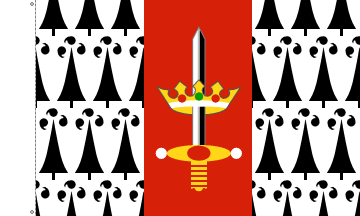
Carolina's flag consists of three vertical stripes—white on each side and red in the center. The white stripes are decorated with black ermine tails, a traditional heraldic symbol representing the Vizcarrondo family, whose members played an important role in the city's founding. Centered on the red stripe are the sword and royal crown from the municipal coat of arms, symbolizing Saint Ferdinand, the city's patron saint.
Coat of Arms
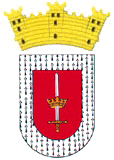
The coat of arms reflects Carolina's history and heritage. The sword and crown honor Saint Ferdinand III of Castile, representing justice, leadership, and faith. The red field commemorates Puerto Rico's first patriotic uprising for freedom, led by Andrés Vizcarrondo, while the ermine border recognizes the Vizcarrondo family's legacy. A mural crown above the shield symbolizes Carolina's municipal autonomy and historical importance.
Anthem
Carolina's official anthem, "Te Cantamos, Carolina", was adopted in 2001 following a municipal competition. The lyrics were written by Migdalia Reyes Hernández, a local educator, with music composed by Rafael Avilés Vázquez. The anthem celebrates Carolina's progress, community spirit, and proud identity as the "Land of Giants" (Tierra de Gigantes).
Human & Capital Resources
Economy
Carolina is one of Puerto Rico's strongest economic centers, driven by tourism, aviation, manufacturing, healthcare, retail, and professional services. The city is home to Luis Muñoz Marín International Airport (SJU), the Caribbean's busiest airport, making Carolina a major gateway for millions of visitors each year and a key hub for transportation, logistics, and commerce.
Tourism plays a vital role in the local economy, supported by the beachfront resorts, casinos, restaurants, and entertainment venues of Isla Verde, one of Puerto Rico's premier tourist destinations. The city also has a strong manufacturing sector that includes pharmaceutical, medical device, food processing, and consumer goods companies. Retail centers, healthcare facilities, financial institutions, and small businesses further contribute to Carolina's diversified economy, making it one of the island's leading centers for employment and economic growth.
Education
Carolina offers an extensive network of public and private schools, making it one of Puerto Rico's leading educational communities. The city is home to several higher education institutions, including the University of Puerto Rico at Carolina (UPR-Carolina), which offers associate and bachelor's degree programs in business, hospitality management, tourism, criminal justice, information systems, education, and aviation-related fields. Its close proximity to Luis Muñoz Marín International Airport has helped the campus develop specialized programs that support Puerto Rico's tourism and aviation industries.
Students also have access to campuses of Universidad Ana G. Méndez, Universidad del Este, and several technical and vocational institutions that offer programs in healthcare, business, engineering technologies, culinary arts, and information technology. Combined with its strong public and private school system, Carolina provides excellent educational opportunities that prepare students for careers in tourism, aviation, healthcare, technology, business, and public service.
Demographics *
Population
154,815
Land Area: 45.32 sq mi
Density: 3,371.90 per sq mi
Median Age: 44.8
Sex: 55% female
Economics **
$16,992
Median household income: $29,398
Puerto Rico: $21,058
Persons below poverty line: 30.5%
Housing, families and educational attainment *
Number of households
61,898
Housing units density:
1,761.7 (2013)
Persons per household: 2.42
High school grad or higher: 86%
Marital status: 30% married
* U.S. Census Bureau 2020 data, unless otherwise noted - Source: Quick Facts Puerto Rico.
** U.S. Census Bureau 2016-2020
Map References
Coordinates: 18.4061° N, 65.9672° W
ZIP Code: 00979, 00981, 00982, 00983, 00984, 00985, 00986, 00987, 00988
Driving Distance from San Juan: 6.9 miles
Driving Time: 16 minutes
Other Resources
Did You Know?
Puerto Rico is home to more than 60 hospitals.
Get Our Newsletter
Discover new places, local flavors, upcoming events, cultural stories, and some of our favorite finds from around the island.Read the Latest ¡La Isla! Newsletter
Follow Along


