
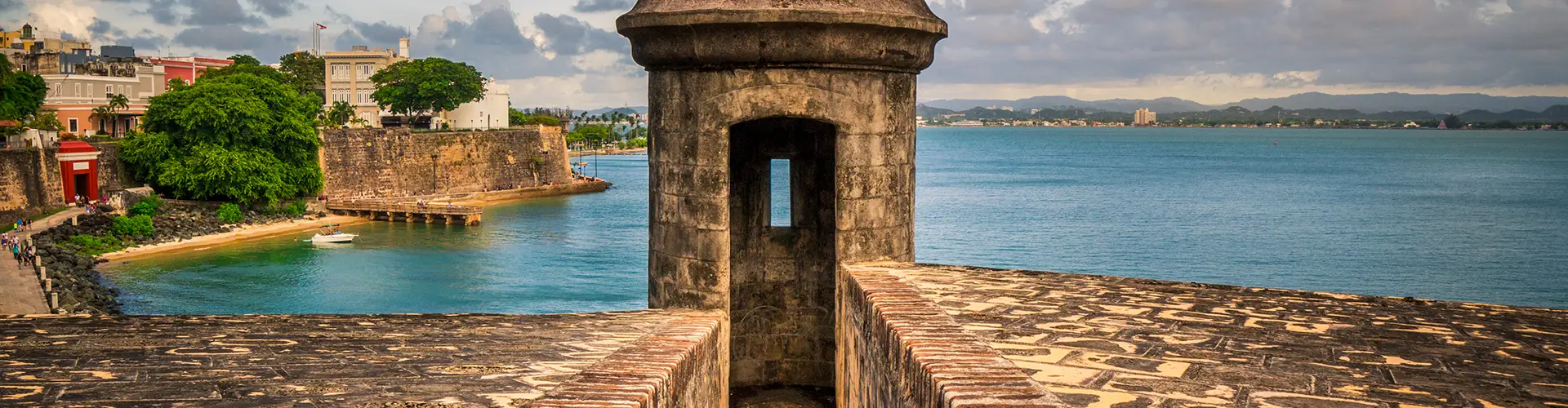
Historic Sites & Forts
Puerto Rico is home to centuries of history preserved in its forts, colonial landmarks, lighthouses, haciendas, and archaeological sites. From the iconic fortifications of Old San Juan to hidden historical treasures throughout the island, these destinations offer a deeper understanding of Puerto Rico's rich cultural and architectural heritage. Browse historic sites by region to plan your journey through the island's past.
Explore Puerto Rico's Historic Sites
Spanish Forts & Castles
Discover the massive stone fortresses that protected Puerto Rico from pirates and invading armies for centuries. From the iconic walls of El Morro to the sprawling defenses of San Cristóbal, these engineering masterpieces offer breathtaking views and fascinating military history.Visit: El Morro • San Cristóbal • Fortín San Juan de la Cruz • Fortín San Gerónimo
Military & Coastal Defenses
Beyond the famous castles, Puerto Rico is home to coastal batteries, historic forts, military museums, and defensive structures that tell the story of nearly 500 years of conflict and resilience.Visit: Ballajá Barracks · Battery Santa Elena · Fortín Conde de Mirasol
Indigenous & Archaeological Sites
Travel even further back in time by exploring Puerto Rico's Indigenous heritage. Ancient ceremonial plazas, petroglyphs, and archaeological parks offer a fascinating glimpse into the lives of the Taíno people long before European settlement.Visit: Tibes Indigenous Ceremonial Center · Caguana Indigenous Ceremonial Park · Cueva del Indio · Parque Ceremonial Indígena de Caguana
Every region of Puerto Rico preserves a different chapter of the island's history. From Spanish colonial fortifications and Indigenous archaeological sites to coffee plantations and elegant town squares, exploring these landmarks is one of the best ways to understand how Puerto Rico has evolved over the centuries.
Explore Museums by Historic Sites & Forts: Metro · East · Central · South · West
Displaying 37 results.
Metro Region
-
Bacardi Rum Plant
Bacardi Rum Plant is the largest rum distillery in the world, processing some 100,000 gallons daily. The tour includes a trolley tour of the distillery and bottling plant, a museum and a free rum cocktail. Tours thru the plant are available. Open for tours Mon-Sat. except holidays, from 9am to 4:30pm. Sunday from 10:00am to 4:30pm. Admissions $15, Seniors $12.Route 888 Km 2.6.
Catano
(787) 788-8400 -
Castillo San Cristobal
San Cristobal Fort was El Morro's partner in the city's defense. Built in the 18th century, was considered the Gibraltar of the West Indies. San Cristobal was supported by a massive system of outworks which provided defense in depth and is is one of the largest defenses ever built in the Americas. Guided tours show visitors through the maze Tue, Thu-Fri at 10am, 11am, 2pm and 3pm. Open daily 9am - 5pm.Norzagaray Street, Old San Juan
San Juan
(787) 729-6653 -
Castillo San Felipe del Morro
El Morro was initially fortified in 1539 and completed in 1589. Rising 140 feet above the sea, its 18-foot-thick wall proved a formidable defense. It fell only once, in 1538, to a land assault by the Earl of Cumberland's forces. The fort is a maze of tunnels, dungeons, barracks, outposts and ramps. Many restorations and expansions contributed to the imposing structure it is today. The area was designated a National Historic Site in February, 1949 with 74 total acres. Tours, orientation, and video presentation are available in English and Spanish. Open daily 9am-5pm. Free admission.Norzagaray Street, Old San Juan
San Juan
(787) 729-6960 -
El Capitolio
The Capitol was built in the 1920's to hold the offices of senators on one wing and those of representatives on the other, with galleries, friezes, mosaics and an impressive rotunda in which Puerto Rico's constitution is exhibited. Mon-Fri 8:30am-5pm.Avenida Ponce de Leon
San Juan
(787) 721-5200 ext. 301 -
Federal Building
The Federal Building was inaugurated the 4th of July of 1914. Is the only building in Puerto Rico with heating system. It was built with American surface plan, on the beginning of the 20th Century.San Juan
-
Fuerte San Geronimo
Located close to Caribe Hilton Hotel.San Juan
-
La Fortaleza
The Fortaleza building, originally built in 1540 as a fortress, but soon later proved inadequate to guard the entrance to the harbor. Built by Charles V and became the official Governor's Residence. The construction began in 1533 with a circular Homage Tower on top of which boaths of courage and fidelity were sworn. Reconstruction and expansions continued throughout the centuries. In 1846, it was remodeled and a neoclassical facade replaced its plain exterior, taking on the palatial splendor it boasts today. The building is surrounded by gardens. Tours in English are available every hour. Reservations required. Open Mon-Fri 9am-4pm. Free admission. West end of Fortaleza Street, Old San Juan.San Juan
(787) 721-7000 ext. 2211, 2288, 2366 -
La Princesa
Built in 1837 and was originally a jail. It was restored to house the headquarters of the Puerto Rico Tourism Company. Arts exhibitions are displayed in a gallery within the building. Open M-F 9:00am-noon, 1:00pm-4:00pm.San Juan
(787) 721-2400 -
Paseo La Princesa
An ideal point of departure for your tour of the historical district, Paseo La Princesa is a beautifully restored 19th century esplanade, where Spanish Colonial gentry once strolled and took in the balmy Caribbean air. The Paseo sweeps from the piers that welcome cruise ships past La Princesa, a restored former 19th-century prison housing the Puerto Rico Tourism Company, around the Old City walls to the entrance of the imposing El Morro Fortress.San Juan
-
Plaza Colon
Originally called St. James Square was renamed in 1893 to honor Christopher Columbus on the 400th anniversary of his discovery of Puerto Rico; bronze tablets at the pedestal of the Columbus statue record important episodes in the explorer's life.San Juan
-
Plaza de Armas
Built in the 16th century as San Juan's "Plaza Mayor" or main square. Plaza de Armas has been an important social gathering place for locals since its inception. More importantly, it served during 200 years as the site for military drills to prepare the city inhabitants for enemy attacks, thus the name "Arms Square". The fountain, surrounded by 100-year-old statues representing the four seasons and which dominates the square.San Juan
-
Plaza del Quinto Centenario
Inaugurated on 12 October, 1992 to commemorate the 500th anniversary of Christopher Columbus discovery of Puerto Rico in 1493, is a modern square on several levels with steps leading to a central fountain. The monumental totemic sculpture symbolizes the earthen and clay roots of American history. Placed around the plaza are fountains, other columns and sculpted steps that represent various historic periods in Puerto Ricos 500-year heritage.San Juan
-
Plaza Juan Ponce de Leon
A pleasant market of provisions, produce, meats, fast food, medicinal plants, jewelry and crafts.San Juan
(787) 284-4141, ext. 460. -
Plaza San Jose
This small square located in Old San Juan, boasts a statue of Juan Ponce de Leon made from cannons captured during the unsuccessful British attack on San Juan.San Juan
-
Plazuela de la Rogativa
A bronze sculpture by Lindsay Daen commemorates a religious procession in 1797 when a priest and women carrying torches and chanting saved San Juan by fooling British ships off-shore into thinking that reinforcements had reached the city.San Juan
-
Puerta de San Juan
As a fortified city, San Juan had six massive doors at different points in the surrounding walls, which were closed at sundown to protect its inhabitants. The only remaining door is located on the western side of the wall and allows you to re-enter the city when using the Paseo La Princesa promenade which borders the San Juan Bay.San Juan
-
San Juan City Hall (Alcadia de San Juan)
Built between 1604 and 1789. In the 1840's the building was heavily remodeled providing its present day facade intended by its builders to be an exact replica of Madrid's. The building has a tourism information center and a small gallery for periodic exhibitions. Free admissions. Open Mon-Fri 8am - 4pm, except holidays.153 Calle San Francisco, Plaza de Armas, Old San Juan
San Juan
(787) 724-7171 Ext. 2391 -
School of Fine Arts
Built by the Spanish colonial government in the 1800s.San Juan
-
Central Constancia
Dating back to 1878, the Central Constancia was a sugar power station dedicated to seed and to grind cane. The central is well-known for having a chimney that used to drive seedtime and the cut of cane and a well preserved steam locomotive. It continued operations until half-full of century XX.Toa Baja
(787) 261-0202
East Region
-
Roosevelt Roads Naval Station
Located approximately 35 miles east of the Luis Munoz Marin International Airport. Naval Station Roosevelt Roads was named for then Assistant Secretary of the Navy Franklin D. Roosevelt, who conceived the idea in 1919 on a surveying trip.Ceiba
(787) 865-2000
Central Region
-
Munoz Marin Mausoleum
Open daily 8:00am-noon 1:00pm-4:30pmBarranquitas
(787) 857-3810 -
Caguana Indian Ceremonial Park
Caguana Indian Ceremonial Park is the most important archaeological deposit in the Antilles. Built by the Taino Indians some 800 years ago. Cobbled walkways birder ten Indian courts. Stone monoliths are decorated with petroglyphs.Route 111, Km 12.3
Utuado
(787) 894-7325
South Region
-
Arroyo Train
Update: Currently closed for renovations. Daily train rides through an old sugar cane plantation.Rt 3 Km 130.9
Arroyo, 00714
(787) 271-1574 -
Central Mercedita
Found in 1870 by Don Jose Ramon de Aponte. In 1938, the facilities packed about 60,000 tons of sugar.Ponce
-
Centro Ceremonial Indigena de Tibes
This ancient Indian site, dating from A.D. 700, includes seven bateyes (ball courts), some carved with petroglyphs, said to have been used for a soccer like game. The site also includes two dance grounds, stones line up with the sun during the equinox and solstice, making Tibes a pre-Columbian astronomical observatory. There is also a reconstructed Taino village, with thatched roof bamboo huts, a museum, an exhibition hall that presents a documentary about Tibes, a cafeteria, and a souvenir shop. Tue-Sun 8:30am-4pm. Admission: Adults $2, children $1.Rte. 503, Tibes., at km 2.2
Ponce
(787) 840-2255 -
La Cruceta del Vigia
For a incredible view of how the mountains meet the sea at Ponce, drive to the summit of El Vigia Hill located in Ponce, where scouts once scanned for attacking ships. Visitors can ascend La Cruz del Vigia, a 100-foot observation tower. Serralles Museum located near to El Vigia Hill, is a lovely landscaped former residence of the Serralles family, producers of Don Q rum. Open Tue-Sun from 9am to 5:30pm.17 Vigia
Ponce
(787) 259-3816 -
Parque de Bombas
Located in Ponce, this unique red and black, century old wooden firehouse is a landmark (and still in use). There are exhibits on the second floor, and the municipal band plays a free concert every Sunday night. Wed-Mon 9:30am-6pm. Admission is free.Plaza Las Delicias
Ponce, 00717
(787) 284-4141, ext. 342.
West Region
-
Central Coloso
Central Coloso is one of the oldest sugar cane processing plants that still in operation in Puerto Rico.Aguada
-
Ermita Espinar Ruins
Built in 1525 on behalf of Nuestra Senora de la Inmaculada Concepcion and on the attempts to convert Taino Indians to Christianity. Open Mon-Fri 8am-noon; 1pm-5pm.Rt 442. Barrio Espinar
Aguada
(787) 868-6442 -
Plaza de Recreo de Aguada
The central plaza for Aguada.Aguada
(787) 868-6242 -
El Mirador de la Bahía
A three-story lookout on a small cliff overlooking Añasco Bay; this is a scenic viewpoint rather than a beach.Rt 115. just south of Rt 109
Anasco
(787) 829-0686 -
Plaza de Recreo
Visit the town's main square.Cabo Rojo
(787) 225-1580 -
Ruinas Ingenio Azucarero Paco Gaztambide
Ruinas del Ingenio Azucarero Paco Gaztambide are the remains of a historic 19th-century sugar mill in Las Marias. The site commemorates the area's early sugarcane industry and its important role in the municipality's agricultural history.Las Marias
-
Casa Aduana
Casa Aduana is one of Mayaguez's most important historic landmarks. Originally built in 1838 to accommodate distinguished visitors arriving at the port, it became the city's customs house in 1898. Rebuilt in a neoclassical style after the 1918 earthquake, the building is listed on the National Register of Historic Places and remains a symbol of Mayaguez's maritime and commercial heritage.Comercio St.
Mayaguez
(787) 831-3342 -
Cerveceria India
Cerveceria India is Puerto Rico's largest brewery and home of the famous India Beer brand. Established in 1937 in Mayaguez, it represents an important part of the island's industrial and brewing history and has an annual production capacity of approximately 800,000 barrels.Mayaguez
(787) 834-1000 -
Christopher Columbus Town Square
Christopher Columbus Town Square is the historic heart of Mayaguez and a favorite gathering place for locals and visitors alike. Surrounded by colorful colonial-era buildings, cafes, and cultural landmarks, the plaza honors Christopher Columbus and serves as the setting for community events, festivals, and everyday life in Puerto Rico's second-largest city.William McKinley Av.
Mayaguez
-
Plaza Colon
An interesting landmark to explore, the Plaza Colon features a large statue of Christopher Columbus that dominates the main square of Mayaguez. Sixteen smaller brass statues imported from Barcelona surround the main monument and add interest to this Spanish-style plaza.McKinley St.
Mayaguez
Why Puerto Rico's Forts Matter
For more than four centuries, Puerto Rico stood at the crossroads of the Spanish Empire in the Caribbean. Ships carrying gold, silver, and supplies between the Americas and Europe passed through the island's strategic harbor, making San Juan one of Spain's most important military strongholds. To defend these valuable trade routes, the Spanish Crown invested heavily in an impressive network of forts, walls, batteries, and watchtowers.
These massive stone fortifications protected Puerto Rico from attacks by pirates, privateers, and rival European powers, including England, France, and the Netherlands. Over the centuries, they withstood famous assaults by Sir Francis Drake in 1595, George Clifford, the Earl of Cumberland, in 1598, the Dutch in 1625, and the British in 1797.
Today, many of these remarkable structures remain standing, offering visitors a chance to walk through nearly 500 years of history. The fortifications of Old San Juan—including Castillo San Felipe del Morro, Castillo San Cristóbal, Fortín San Juan de la Cruz (El Cañuelo), and the city walls—were recognized as a UNESCO World Heritage Site in 1983 for their outstanding military architecture and historical significance.
Puerto Rico Through the Centuries
Why I Love Puerto Rico's History
Growing up in Puerto Rico, history was never something confined to textbooks. It was woven into everyday life. School field trips often took us to centuries-old forts, town plazas, and museums where we could walk through the same streets that witnessed pirates, explorers, Spanish soldiers, and generations of Puerto Ricans who shaped the island's story.
Today, every visit still reminds me that Puerto Rico is much more than beautiful beaches. Behind nearly every historic building is a story waiting to be discovered, and taking the time to explore these places has given me an even deeper appreciation for the island I still proudly call home.
Insider Tip
Growing up in Puerto Rico, visiting El Morro usually meant flying kites, running across the enormous green lawn, and enjoying piraguas afterward—not realizing we were playing beside a fortress that had protected the island for nearly 500 years. It wasn't until I was older that I truly appreciated its history. Today, every visit reminds me how Puerto Rico's historic sites are places where history and everyday life come together.
Don't limit yourself to San Juan's famous forts. Some of my favorite historic discoveries have been found in small-town plazas, old churches, coffee haciendas, and sugar mill ruins scattered across the island. They often tell just as compelling a story—with far fewer crowds.
Frequently Asked Questions
Which fort should I visit first?
If it's your first visit to Puerto Rico, start with Castillo San Felipe del Morro. Its dramatic oceanfront setting, iconic lighthouse, and panoramic views make it one of the island's most recognizable landmarks. If time allows, visit nearby Castillo San Cristóbal on the same day.
How many Spanish forts are in Puerto Rico?
Puerto Rico is home to numerous Spanish military fortifications. The most famous are Castillo San Felipe del Morro, Castillo San Cristóbal, Fortín San Juan de la Cruz (El Cañuelo), and Fortín San Gerónimo, along with historic city walls, batteries, and smaller defensive structures around the island.
Is El Morro free to visit?
The grounds surrounding El Morro are free to enjoy, including the famous lawn where families gather to fly kites. Admission is required to enter the fort itself, and tickets also include access to Castillo San Cristóbal through the U.S. National Park Service.
How long should I spend at El Morro?
Plan to spend 2–3 hours exploring El Morro. If you're visiting both El Morro and San Cristóbal, allow at least half a day to fully enjoy the exhibits, tunnels, ramparts, and scenic viewpoints.
Are Puerto Rico's forts good for children?
Yes. Many families enjoy visiting the forts because they combine history with open spaces, ocean views, tunnels, and plenty of opportunities to explore. Children especially enjoy walking along the old walls and watching kite flyers outside El Morro.
Which forts are UNESCO World Heritage Sites?
Castillo San Felipe del Morro, Castillo San Cristóbal, Fortín San Juan de la Cruz (El Cañuelo), and the historic city walls of Old San Juan are all part of the La Fortaleza and San Juan National Historic Site, designated a UNESCO World Heritage Site in 1983.
What is the oldest building in Puerto Rico?
One of the oldest surviving buildings is Casa Blanca, constructed in 1521 as the intended residence of Juan Ponce de León's family. It is now a museum showcasing colonial history and beautiful gardens.
Can you visit La Fortaleza?
Yes, La Fortaleza, the official residence of Puerto Rico's governor, offers guided tours by reservation on select days. The building is also part of the UNESCO World Heritage Site in Old San Juan.
Did You Know?
The Capitol of Puerto Rico, located in San Juan, houses both chambers and is an architectural landmark completed in 1929.
Get Our Newsletter
Discover new places, local flavors, upcoming events, cultural stories, and some of our favorite finds from around the island.Read the Latest ¡La Isla! Newsletter
Follow Along


